Test 1: one million records on AWS EKS and RDS
Run on 22 January 2022. Databunker OSS was deployed on AWS with the Terraform configuration and Helm chart from the repository. A single EKS node ran the Databunker container, and a single MySQL RDS instance held the data.Resource utilization (t3.xlarge)
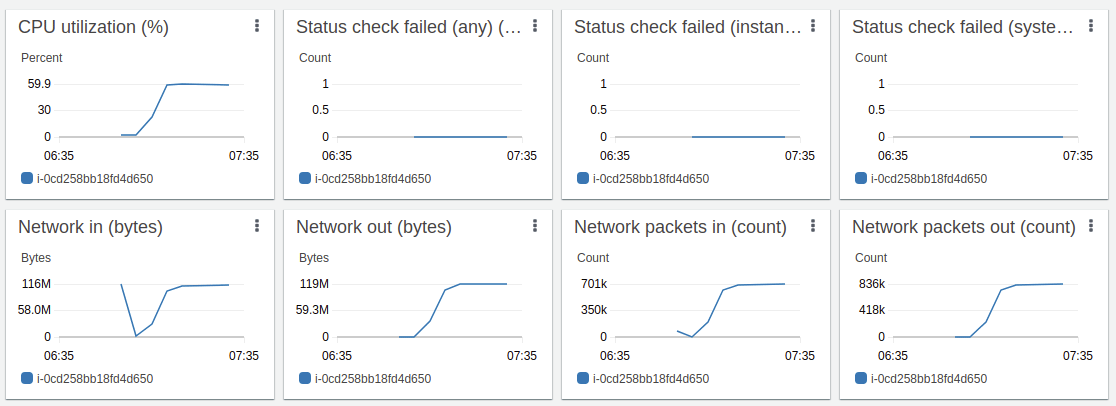
EKS node utilization during the test
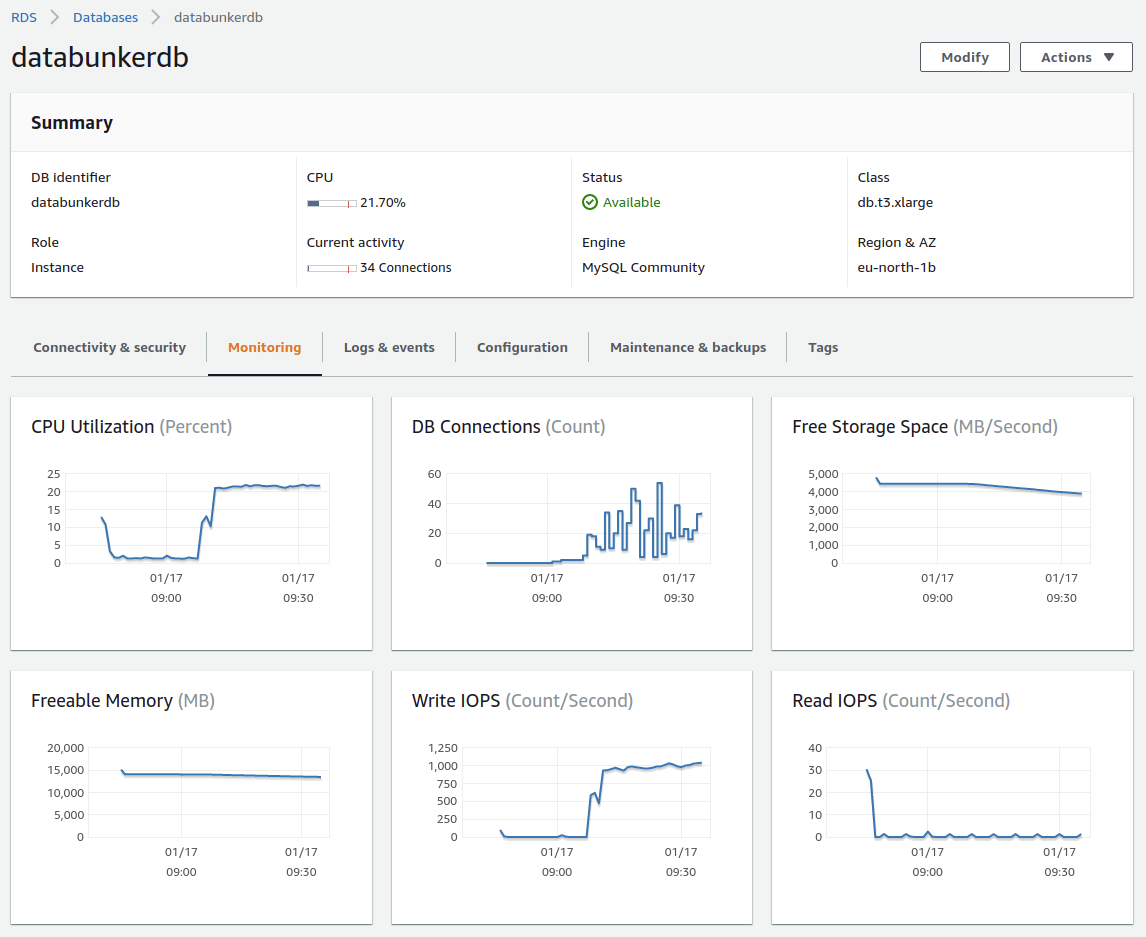
MySQL RDS db.t3.xlarge utilization during the test
How to reproduce
- Deploy the stack with the Terraform configuration for AWS.
- Start a separate EC2 instance to run the load script below.
requests.Session(), so connections are reused; Databunker supports HTTP keep-alive.
stress-test.py
Test 2: full stack on one 1 GB droplet
Run on 11 April 2021. Every component ran on one DigitalOcean droplet with 1 GB RAM, 1 Intel CPU and a 25 GB NVMe SSD:- Databunker, as a Docker container
- MySQL, as a Docker container
- A Node.js app server
- ApacheBench (
ab) generating the load
SELECT), decrypts it, writes an audit event (INSERT), and returns the record to the app server, which prints the user’s email. The Node.js HTTP agent was configured to reuse open sockets.
Result: the app server sustained 155 requests per second while loading every response from Databunker, with no failed requests and a 95th-percentile latency of 95 ms.
App server
server.js
Load command and output
Full ApacheBench output
Full ApacheBench output