What is a PII Vault?
The PII Vault is Databunker Pro’s core feature that transforms how organizations handle sensitive personal data. Instead of storing PII directly in your application database, the PII Vault:- Encrypts and tokenizes entire user records using AES-256 encryption
- Generates secure UUID tokens that can be safely stored anywhere
- Maintains searchable indexes using secure hash-based lookups
- Provides audit trails for every data access and modification
- Enables compliance with GDPR, HIPAA, SOC2, and other privacy regulations
Why Use PII Vault Instead of Regular Database Tables?
Traditional Database Approach Problems
- ❌ Data exposure in logs, backups, and error messages
- ❌ SQL injection vulnerabilities expose sensitive data
- ❌ Database admin access reveals all personal information
- ❌ Compliance complexity requires extensive additional controls
- ❌ Breach impact exposes all stored PII immediately
Databunker Pro PII Vault Solution
Instead of storing PII in your application database, store only the user secure tokens (in UUID format):- ✅ Zero PII exposure in application databases, logs, or backups
- ✅ Breach protection - attackers only see meaningless tokens
- ✅ Built-in compliance with privacy regulations
- ✅ Simplified architecture - no complex encryption management
- ✅ Audit-ready with comprehensive access logging
How PII Vault Works
1. Data Ingestion and Tokenization
When sensitive data enters your system, Databunker Pro:- Accepts complete user profiles in JSON format
- Extracts searchable fields (email, phone, login, custom) for indexing
- Encrypts the entire record using AES-256 encryption
- Generates a secure UUID token for the record
- Stores encrypted data in the secure vault
- Creates hashed search indexes for efficient lookups
2. Uniqueness and identity resolution
The hashed search indexes onemail, phone, login, and custom are unique within a tenant. This has three practical consequences:
- Duplicates cannot coexist inside the same tenant. A second attempt to create a user record under an existing email / phone / login / custom value is rejected at the vault level — identity uniqueness is a structural guarantee, not a discipline.
- Repeat identities resolve to the same token. When the same person appears again, look them up by their indexed field and reuse the existing token; there is no risk of accidentally minting two tokens for the same underlying identity.
- Different tenants can hold their own record for the same person. Tenants are cryptographically isolated boundaries (enforced with PostgreSQL row-level security, and also supported on MySQL and Oracle), so the same email tokenised in two tenants produces two different tokens — this is the basis of the multi-tenant, multi-token pattern used for separating analytics, operational, and external-integration domains.
email can join on user_token with no round-trip to the vault.
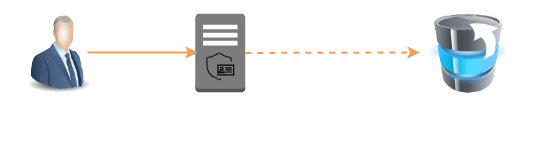
3. Secure Storage Architecture
Code Examples: Storing and Retrieving User Records
Storing User PII
- cURL
- JavaScript
- Python
Retrieving User PII
- Retrieve by Token
- Retrieve by Email
- Retrieve by Phone
Security controls
Records are encrypted with AES-256, access is governed by role-based policies, and every request is written to the audit trail. Tenants are isolated at the database level on PostgreSQL, and the application tier scales horizontally. See the Security overview for the full control set.Next steps
- Quickstart — run a vault and store your first record in one command
- Search the vault — exact, fuzzy, and partial lookups over encrypted records
- Tokenize credit cards — format-preserving tokens for PCI data
- Performance and sizing — measured throughput and instance sizing by record count
- Licensing and limits — what counts as a record